The Metal
Everything Tuoom makes is cast from the same alloy, so everything worth saying about the metal is said here once rather than repeated on each product. The elemental assay in full, trace elements and lead reading included. What the Ayurvedic tradition holds, framed as tradition. How to look after it. And, plainly, the test we have not run.
Material Comparison
| Kansa (Tuoom) | Stainless Steel | Melamine / Plastic | |
|---|---|---|---|
| Material | 78:22 copper-tin bronze | Steel alloy | Moulded plastic |
| Finish | Hand-finished, laser-engraved | Machine-pressed | Printed |
| Ages with use | Develops a patina | Stays uniform | Scratches and dulls |
| Traditional use in India | 3,000+ years | Modern | Modern |
| Composition | 78:22 copper-tin | Varies by grade (304/201) | Varies by resin |
| Lifespan | Decades, repairable | Years | Replaced periodically |
| Care | Hand-wash | Dishwasher | Dishwasher |
Material & Testing
Tuoom's 78:22 claim rests on one piece of lab work — an elemental composition assay of the alloy the Kids Thali Set is cast from. Rather than summarise it for you, we publish the numbers, trace elements included. And we are equally clear about the test we have not run, and about which pieces this assay covers.
78 : 22 Alloy
78.43% copper and 21.15% tin, measured on the alloy the Kids Thali Set is cast from. Together those two elements are 99.58% of the metal.
The Test
It measures what the metal is made of, element by element. That is what it does, and all it does. It is not a food-contact or migration test, and we do not present it as one.
No Coating
Nothing plated, lacquered, tinned or lined. Unlike pure copper vessels, kansa needs no kalai re-coating — and it means the metal the assay measured is the same metal the food touches, with no separate surface layer behaving differently.
The assay answers one question — what is this metal made of — and answers it element by element. Reading down the table, the zinc figure of 0.084% is worth pausing on: it settles a question worth asking of anything sold as kansa in India, since brass is copper and zinc, usually 30% zinc or more.
| Element | % by weight* | What it is |
|---|---|---|
| Copper (Cu) | 78.430 | Base metal of kansa |
| Tin (Sn) | 21.150 | The second element — the copper-to-tin ratio is what makes bronze bronze |
| Phosphorus (P) | 0.093 | A standard deoxidiser in bronze casting |
| Zinc (Zn) | 0.084 | Brass is 30%+ zinc — this is not brass |
| Nickel (Ni) | 0.056 | Trace, from the copper feedstock |
| Iron (Fe) | 0.040 | Trace, from the copper feedstock |
| Antimony (Sb) | 0.024 | Trace, from the copper feedstock |
| Bismuth (Bi) | 0.023 | Trace, from the copper feedstock |
| Lead (Pb) | 0.010 | Trace impurity, see below |
Copper and tin together are 99.58%. Every other element listed adds up to 0.33%. The nine figures total 99.91%; the remaining 0.09% is balance the assay did not resolve into a named element. *Figures are from an elemental assay of a representative production sample of the alloy the Kids Thali Set is cast from. Kansa is cast in batches, and small variations between batches are normal; 78:22 is the nominal ratio the alloy is made to, not a per-unit guarantee, and the assay covers the sample tested rather than every piece we make.
The assay reports lead at 0.010% — one part in ten thousand, or 100 parts per million. We publish that figure rather than round it away, because a table showing only the flattering rows would not be worth reading.
Lead is not an ingredient in kansa. It turns up as a trace impurity in copper ore and in the feedstock alloys are made from, which is why copper alloys are specified with a permitted lead limit rather than as containing none of it at all.
What that number does not tell you is how much of it, if any, reaches food. That is a different question and it takes a different test — a migration test — and that is the one we are commissioning.
A composition assay says what a metal is. It does not say what transfers into food. That is a separate migration or leaching test, which puts the finished article in contact with a food simulant under set conditions and measures what comes off it. Claims about food contact rest on that test, not on this one. We have not run it, no independent body has assessed any Tuoom product against a food-contact standard, and you will not find purity or food-contact claims anywhere on this site. Migration testing is commissioned; a migration test measures one specific article under set conditions, so each result we publish will name the piece it was run on — numbers first, whatever they say.
If you would rather read the assay yourself than take our summary of it, message us and we will send it over.
Ask us for the reportThe Tradition Behind The Table
Kansa is bell-metal — an alloy of roughly 78% copper and 22% tin. It is distinct from brass (copper and zinc) and from pure copper vessels; the specific copper-tin ratio is what gives kansa its characteristic golden-bronze tone, ring, and the properties Ayurveda has long associated with it.
Within Rasa Shastra, the Ayurvedic branch concerned with metals and minerals, kansa is traditionally classified as a Mishra Loha — a mixed or compound metal — placing it in a distinct category from single-element metals used in classical Ayurvedic practice.
Ayurveda holds that kansa has a naturally balancing effect across all three doshas — Vata, Pitta, and Kapha — which is part of why it was traditionally considered an appropriate everyday metal for the whole family, rather than suited to one constitution alone.
Eating from kansa is traditionally believed to stimulate and support Agni, the digestive fire — one of the most cited reasons kansa thalis have historically been the everyday choice at Indian meal times.
In Ayurvedic thought, kansa is considered a sattvic metal — associated with clarity, calm, and balance — and was traditionally favoured for daily dining and for offerings in temple settings for this reason.
Unlike the traditional beliefs above, this one is a measured property of the material: copper and its alloys exhibit the oligodynamic effect, a documented antimicrobial property of the metal surface itself. We note this as a property of kansa as a material — not as a medical claim about any Tuoom product, and not as a claim that water or any other drink kept in a Tuoom vessel is purified, disinfected or made safer.
Kansa dinnerware has anchored Indian household and temple dining for over three millennia, appearing across regional traditions from Bengal to Kerala — one of the longest continuously used metal-craft traditions in the world.
This isn't nostalgia — it's rediscovery. As households weigh what actually lasts, they are choosing materials that age well instead of wearing out, and a tradition once simply inherited is being examined on its own terms and kept by choice rather than by default.
Everything here describing Ayurvedic properties reflects traditional belief and long-standing practice, not medical claims. Tuoom makes no health or therapeutic claim for any of its products.
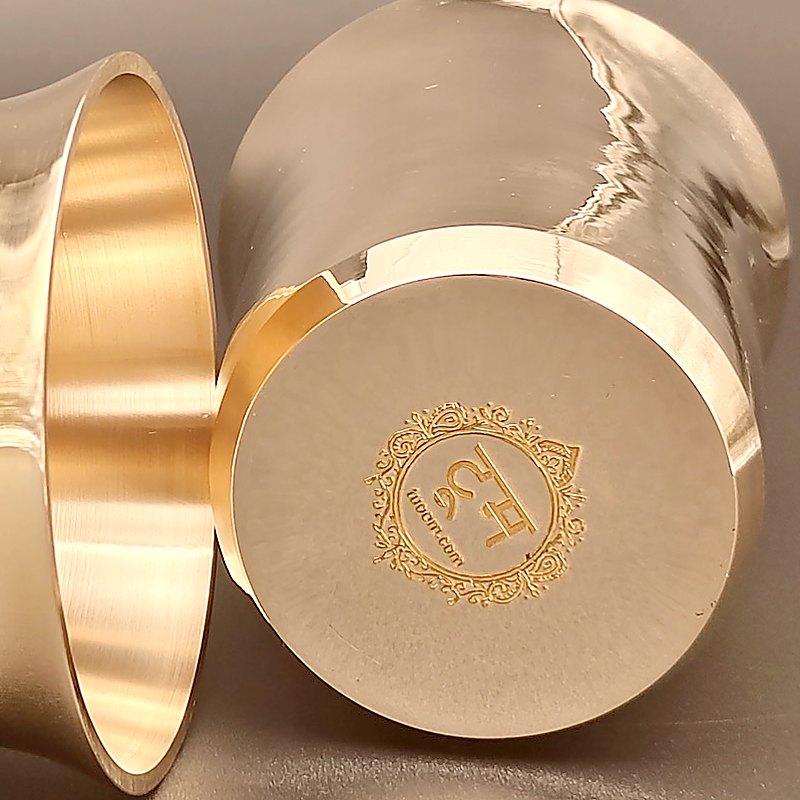
The Mark
Turn a piece over and there it is, stamped into the metal: our own mark, the same on everything we make. It is how you tell a Tuoom piece from anything else on a shelf, and how you will still tell in thirty years, when the shine has gone to patina and the box is long gone.
This is Tuoom’s own identifying mark. It is not a hallmark, an assay stamp, or any third-party certification, and it does not carry a meaning beyond telling you who made the piece.
Care & Use
Kansa asks for a little more than steel and gives back decades. None of this is fussy — it is the same handful of habits Indian households have kept around bell-metal for generations.
Warm water and a mild dish soap, by hand — not in a dishwasher. Avoid harsh scouring pads, and dry each piece straight away with a soft cloth. Water left to sit is what dulls the finish fastest.
Bronze handles hot and cold comfortably for serving. It is not a storage container: food left standing in any copper alloy has time to react with it.
Tamarind, lemon, tomato-heavy curries and pickles all react with copper alloys. Serve them in another vessel. The same chemistry is why a lemon-and-salt or tamarind rub is the traditional way to bring the shine back — useful on the outside, not something to leave sitting inside.
It is solid metal. It belongs at the table and at the sink — never in a microwave, never on an induction hob, and never over direct heat.
Solid bronze darkens gently with use. That is the material behaving normally and, to most people who grew up with it, the point. Regular washing and drying keeps it brighter for longer if you prefer the shine.
Unlike pure copper vessels, kansa needs no periodic tin-coating. The alloy itself is the finished dining surface, and there is no lining to wear through or renew.
Not yet, and we will not say otherwise. The lab work we hold is an elemental composition assay: it confirms the alloy is 78:22 copper-tin and reports every trace element found in it, and we publish it in full in the Material & Testing section of this page. Safety in food contact rests on a different test — a migration test, which measures what transfers from the finished article into food under set conditions. We have not run one. We hold no food safety certification, and we make no purity or toxicity claim for any Tuoom product, anywhere on this site. Migration testing is commissioned, and each result we publish will name the piece it was run on.
Kansa has been used for everyday Indian dining for thousands of years, and unlike pure copper it needs no tin-coating (kalai) to serve as a dining surface. Our lab work is an elemental composition assay: it confirms 78.43% copper and 21.15% tin, with every other element together under half a percent, and we publish it in full in the Material & Testing section of this page. It is a composition test and not a migration test — we have not run one — so it says what the metal is made of, not what transfers into food. In use: serve from it rather than store food in it, put very acidic or sour dishes in another vessel, and hand-wash and dry each piece after the meal.
No. Unlike pure copper vessels, kansa (bronze) does not require periodic kalai re-coating — the alloy itself is the finished dining surface.
Yes — a gradual, gentle darkening or patina is natural for solid bronze and is considered part of its character, not a flaw. Regular hand-washing and drying will keep the shine bright for longer.
Warm water and a mild dish soap, hand-washed and dried immediately with a soft cloth. For deeper shine, a natural tamarind or lemon-and-salt polish (a traditional Indian method) works well. Hand-wash only — it is not dishwasher safe, and as solid metal it must never go in the microwave or on an induction hob.
Yes, bronze handles both comfortably for everyday serving. Use it to serve rather than to store food, and serve very acidic or sour dishes in another vessel — like any copper alloy, kansa reacts with them. Avoid direct stovetop or open-flame contact.